Body Shop Downtime: How Industrial Facility Management Services Help
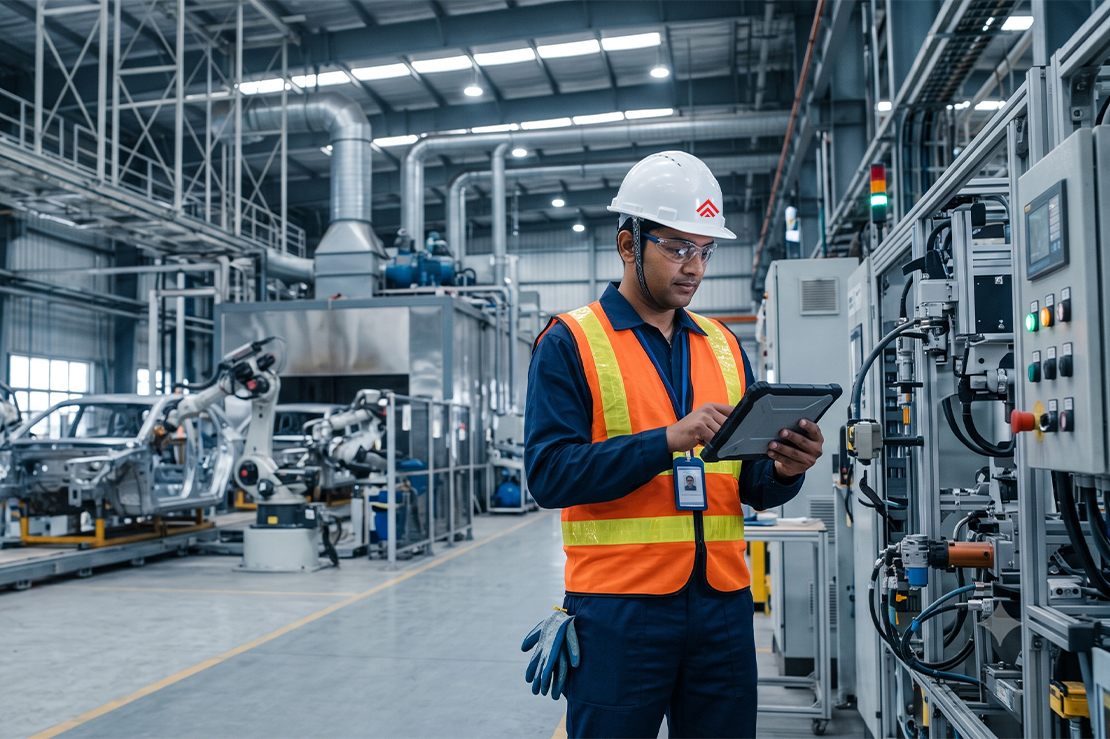
Body shop production depends on more than efficient machinery and skilled teams. Reliable industrial facility management services help keep the systems supporting production safe, functional, and ready to perform. When these systems begin to underperform, production delays can quickly follow.
What Happens When Body Shop Production Slows?
A body shop runs on tight interdependencies. Conveyors, spray booths, bake ovens, and paint lines are all connected, so one system going off-spec sends ripples downstream fast. Operators make ad hoc calls, quality checks get skipped, and rework volumes climb. Downtime rarely announces itself. It builds through a clogged filter, a skipping chain, or a pump running low because someone cleaned the wrong filter and never logged it.
How Industrial Facility Management Services Identify the Cause of Production Delays
Checking Production Equipment Beyond the Visible Breakdown
When a bake oven trips, the obvious call is the burner or temperature controller. Experienced FM teams go deeper, checking fan airflow, damper response, and exhaust restriction. A visible fault is sometimes the last thing that broke, not the first.
Reviewing Maintenance History and Recurring Equipment Issues
CMMS data reveals patterns most plant managers never read: a robot recalibrated four times in eight months, a drive tripping overloads at shift changeover, or a booth showing low airflow every weekend shutdown. These patterns point to root causes that scheduled maintenance alone will not fix.
Identifying Problems Across Connected Production Systems
A chemical bath temperature drop is not always a solution problem. It could be a fouled heat exchanger or a chiller running below capacity. FM teams working across the full facility make cross-system connections that internal teams, focused on their own station, routinely miss.
How Body Shop Maintenance Services Prevent Production Interruptions
Inspecting Body Shop Equipment Before Production Starts
Pre-shift inspections are not a checkbox exercise. A trained FM technician checks filter pressures, conveyor speed, and booth temperature and humidity before a shift begins. Something caught early gets fixed on time, keeping things moving along nicely.
Identifying Early Signs of Equipment Wear and Failure
Conveyor chains wear gradually. Bearings run warmer before they seize. Pump impellers lose pressure before they fail. Teams using vibration analysis and thermal imaging catch these signals when correction costs planned hours.
Coordinating Maintenance Without Disrupting Production
The most technically sound plan fails if it conflicts with production schedules. FM teams work within shutdowns, shift breaks, and weekend downtime to run tasks without creating new bottlenecks.
How Industrial Equipment Maintenance Helps Reduce Production Downtime
Critical equipment comes first: paint pumps, oven burner trains, conveyor drives. Small faults get fixed before they become mid-shift stoppages. Reliability must be consistent across the full line, because one neglected station determines output for everyone.
What Can Manufacturers Do When Production Downtime Keeps Increasing?
Three things determine impact: which equipment gets inspected, how fast findings are acted on, and whether that action feeds into the next maintenance cycle.
- Critical equipment first. Paint circulation pumps, ED rectifiers, oven burner trains, conveyor drives. These are the systems where failure halts production outright, not just degrades it.
- Small faults fixed on the spot. A pressure drop on the paint supply line is a 30-minute fix at the right time. Left alone, it becomes an unplanned stop mid-shift.
- Reliability is built across the full line. One well-maintained station next to a neglected one means the weak link always determines output. OEE numbers only move when coverage is consistent.
Final Thoughts
A body shop that runs well does not just have good machines. It has a maintenance structure that knows what to watch, when to act, and how to act without stopping production. Not heroics when things break. That is where UPS comes in.
We build the maintenance structure behind the operation, so your teams can focus on production while we focus on keeping the facility running right.
Check out our industrial facility management services and see how UPS can support your facility. Visit upsfm.com.
Frequently Asked Questions About Industrial Facility Management Services
What Do Industrial Facility Management Services Include in a Manufacturing Plant?
Preventive and predictive maintenance across production equipment, utility systems, conveyors, workshop equipment, and compliance checks, scoped against the plant asset register and criticality classification.
How Do Body Shop Maintenance Services Reduce Production Downtime?
Catch degradation before it becomes a failure. Pre-shift checks, condition monitoring, and cross-system fault correlation reduce the frequency and duration of unplanned stops.
What Does Industrial Equipment Maintenance Cover?
Mechanical systems, electrical systems, process equipment like paint booths and bake ovens, robotic arms, and building utilities that control air quality, temperature, and humidity.
What Are the Common Causes of Production Downtime in a Body Shop?
Conveyor chain failures, spray booth filter chokes, AHU faults, paint pump issues, robot calibration drift, oven burner trips, and bath parameter deviations. Most have detectable warning signs if the right data is being tracked.
How Can Maintenance Teams Identify the Root Cause of Equipment Failures?
Through CMMS failure history, vibration and thermal trending, cross-system symptom mapping, and structured root cause analysis. Consistent data logging separates patterns from one-off events.
How Can Industrial Facility Management Services Improve Equipment Reliability?
By shifting to condition-based inspection, replacing parts based on wear data, and coordinating maintenance windows with production schedules so that neither competes with the other.
Have any feedback or questions?
Contact us!