Blocked Fire Exit? How Fire Safety Management Services Prevent Emergencies
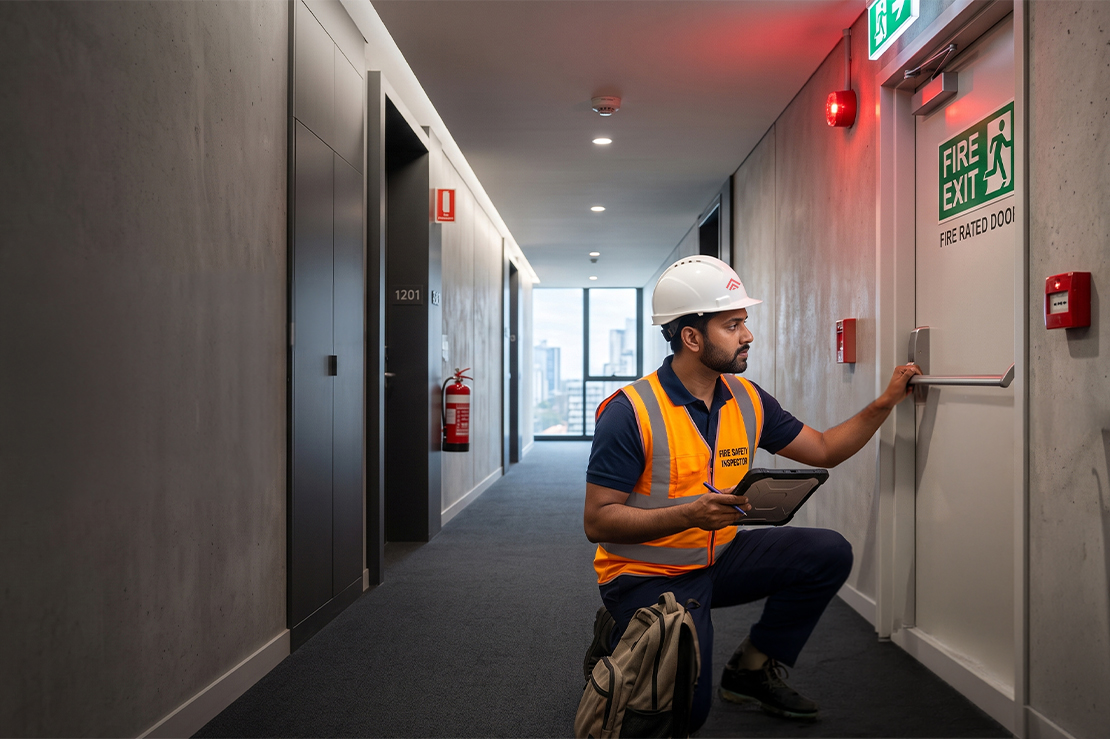
A blocked fire exit rarely looks like a violation. It’s a bicycle in the stairwell, cartons against a fire-rated door, a padlock added ‘for one night’ for stray cats. None of it looks dangerous on an ordinary Tuesday. It becomes dangerous when smoke fills that stairwell, and the exit residents counted on adds ninety seconds to an evacuation that should have taken ten. Fire safety management services exist so Tuesday never becomes that night.
Inspections Catch What a Casual Glance Misses
A real inspection looks past the obvious. Fire-rated doors carry an FRP (fire-resistance period) rating of 30, 60, 90, or 120 minutes. And that rating is worthless the moment the self-closing hinge loses tension and the door stops swinging shut on its own—a fault most residents walk past daily without noticing. Detection matters as much as containment: an addressable panel pinpoints the exact device that triggered an alarm on the floor, corridor, or room, while an older conventional panel only narrows it to a zone, costing precious minutes deciding where to actually go.
What Security Does the Moment an Alarm Fires
The first ninety seconds decide whether a response is orderly or chaotic: confirming a real trigger against the addressable panel’s exact location, opening the correct evacuation route rather than the nearest door, and keeping the driveway clear so a fire tender isn’t stuck behind someone’s car. Coordinating that with residents and the arriving crew separates a guard from a first responder.
Why Fire Safety Management Services Matter as a Proactive Response
Most apartment fires start electrically: a loose connection, an overloaded socket, and a DG room used as storage. Preventive maintenance on a calendar, not after a complaint, keeps the fire from starting at all, and it extends beyond the obvious systems. Fire dampers sitting inside AC ductwork need periodic drop tests to confirm they’ll actually seal against spreading smoke, and a wet riser needs its water column tested under pressure. The same logic covers common areas: a corridor cluttered with overflow furniture is the same corridor meant to stay smoke-free long enough for someone to get out.
Preparedness Isn’t Just Responding to a Plan You’ve Rehearsed
A safety management system assigns clear roles: who calls the brigade, who checks the refuge floor, and who accounts for residents per floor, so nobody improvises mid-emergency. None of it holds without drills, and a predictable drill only tests one thing: whether people can walk downstairs on request. It doesn’t test whether the stairwell’s pressurisation fans will actually switch on and keep smoke out of that route when it’s real.
Someone Has to Coordinate All of This
Inspections, security, maintenance, and drills only work as a system if one team tracks all four against each other. A fire door fault found during inspection needs to reach the maintenance queue the same day, not the next audit cycle, and a security team’s post-incident notes need to feed back into what the next drill actually tests. That handoff is where fragmented vendors quietly break down, not because any one piece is missing, but because nobody owns the gap between them.
If You Find a Blocked Exit Today
- Report it to the facility or security desk immediately.
- Move a bag or bicycle yourself if it’s safe; leave a locked door for staff to handle.
- Ask when the fire NOC was issued and when the last audit was done; a slow answer is a red flag.
- Get it logged in writing, not just flagged verbally.
Conclusion
A blocked exit is never really about that one door; it’s about whether inspections, security, maintenance, and drills are talking to each other before the night that matters. That’s the gap we built our approach at UPS around: fire safety folded into the same facility management contract as everything else, not a separate line item nobody owns. If you’d rather have your building walked through against everything above than find the gaps the hard way, check out our website to see how we work.
Frequently Asked Questions About Fire Safety Management Services
- What are fire safety management services in an apartment building?
The combined system of inspections, alarm monitoring, evacuation planning, and maintenance that keeps fire safety functional.
- Why are fire safety inspections important in residential buildings?
Equipment degrades and habits drift; inspections catch problems before an emergency does.
- What does a fire security service include?
Alarm response protocols keyed to the panel’s exact trigger location, plus coordinating access for firefighters and emergency vehicles.
- How does apartment building maintenance support fire safety?
Keeping electrical systems and common areas from becoming the ignition source or the obstruction.
- What is a safety management system in residential facility management?
Documented roles, evacuation plans, and drills that turn fire safety into a practised routine.
- What do apartment facility management services cover for fire safety?
Coordinating inspections, security, maintenance, and resident reports under one accountable team.
Have any feedback or questions?
Contact us!