Predictive Maintenance in Manufacturing: How Sensors Catch Failures Before They Cost You Production
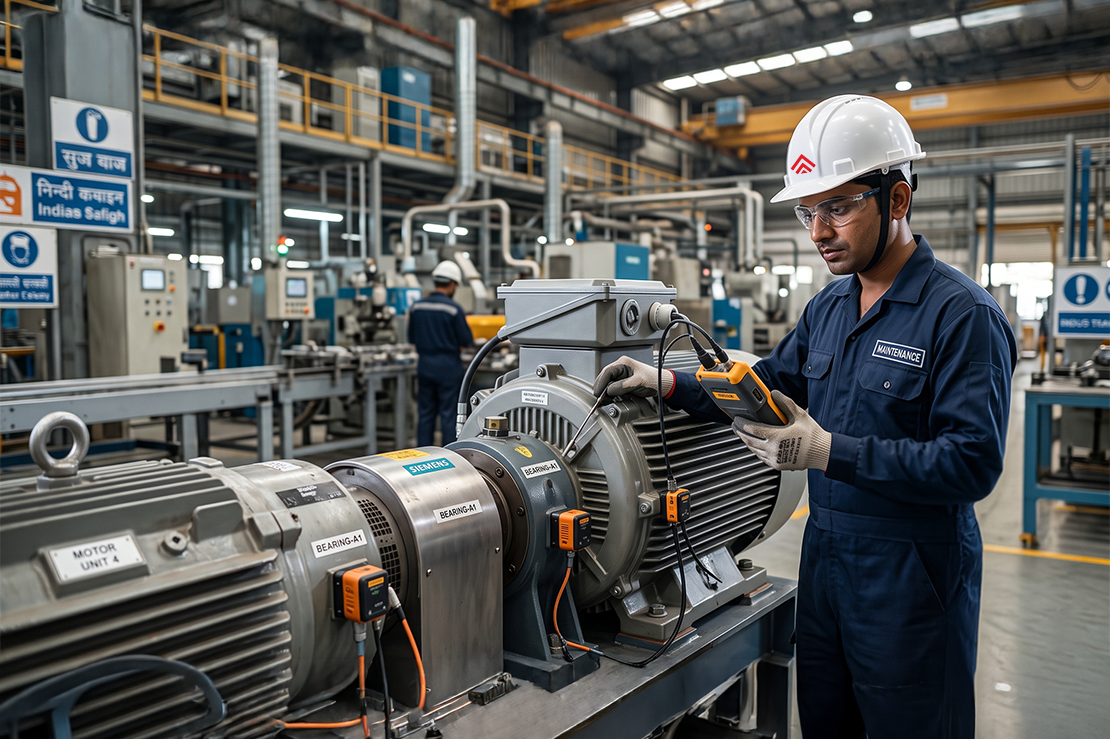
A bearing doesn’t fail all at once. It heats up a fraction, vibrates a fraction more, and draws slightly more current, days before it seizes and takes a line down with it. Predictive maintenance catches that fraction. It’s a form of condition-based maintenance (CBM), a step ahead of reactive maintenance (fix what’s broken) and preventive maintenance (service on a fixed calendar regardless of condition), servicing equipment only when it actually signals it’s due.
How It Works, and the Tech Doing the Watching
Vibration, temperature, and acoustic sensors stream data against calibrated thresholds, not a monthly walk-round. When a reading drifts outside its band, an alert fires, flagging a fault while there’s still time to plan a repair, not a breakdown. Above that sits the reporting layer: IoT (Internet of Things) sensors doing the sensing, SCADA (Supervisory Control and Data Acquisition) and dashboards doing the visualising, and increasingly AI or machine learning models trained on failure history estimating RUL(Remaining Useful Life) in days rather than just flagging a binary alert.
What It Catches Early, and Why Plants Are Shifting to It
The signs stay consistent: bearing wear shows up as a specific defect-frequency spike before it shows up as noise, overheating as thermal drift before smoke, lubrication breakdown as rising friction before seizure, and electrical faults as current or voltage fluctuations before a tripped breaker. Catching these early is why plants are shifting this way: downtime is expensive in a way a fixed calendar can’t budget for, compliance pressure keeps rising, and a shrinking pool of skilled technicians makes it more valuable to send someone to the one machine that needs attention, not walk the whole floor on schedule.
How Industrial FM Services Put This into Practice
In practice, it runs as a cycle: sensors calibrated to each asset’s own baseline, data monitored on a defined rhythm, technicians working off a response protocol tied to alert severity, not a first-come queue, and spares planned around what’s likely to fail next, not what broke last time. The results show up in numbers most plants already track but rarely connect back to maintenance strategy: MTBF (mean time between failures) goes up and MTTR (mean time to repair) goes down because the fault and the part are both known before the technician arrives, and OEE (overall equipment effectiveness) climbs because the machine is actually running instead of waiting on an unplanned fix.
Quick Checklist: Is Your Plant Ready?
Do you know which machines cost the most in downtime, not just which are oldest?
Can sensors be calibrated to that machine’s own baseline, not a generic default?
Are alerts tiered by severity, or one long queue?
Is your spares plan built around predicted failure, or last year’s breakdown?
Why Predictive Maintenance Is Built into Our Industrial FM Services
None of the above matters without someone reading the data the day it’s generated, which is where our model comes in. We’ve run industrial facility management since 2006, and predictive maintenance isn’t an upsell bolted onto a plant contract; it’s part of how we already service machine shops and manufacturing floors. The technicians reading the sensors and interpreting FFT spectra are our own trained staff, not a subcontractor forwarding a monthly report, backed by ISO 9001 and OHS (Occupational Health and Safety) certifications.
FAQs
What is the difference between predictive and preventive maintenance?
Predictive maintenance reacts to real-time condition data; preventive maintenance runs on a fixed calendar regardless of condition.
How much does predictive maintenance cost for a manufacturing plant?
Cost depends on asset count, sensor type, and plant complexity; treat any flat number as a placeholder until a site audit.
What sensors are used in predictive maintenance?
Vibration, temperature, acoustic, and current sensors form the common baseline, chosen per asset type and cross-checked against standards like ISO 20816.
Can predictive maintenance be added to older or legacy machines?
Yes, retrofitting legacy machines is common, and often the highest-value place to start, since older assets fail more often and have thinner failure history to learn from.
Conclusion: From Fixing Failures to Preventing Them
That’s the real shift: not the sensor brand, but who’s watching the data and what they do with it. A plant that knows a bearing’s RUL is measured in days runs a different operation than one that finds out when the line stops. If you want a facility management partner built around excellent preventive and predictive maintenance instead of reactive firefighting, we’re here to help. Check out upsfm.com to see how we can work with your plant.
Have any feedback or questions?
Contact us!