Elevator Downtime: Keeping Apartment Lifts Running
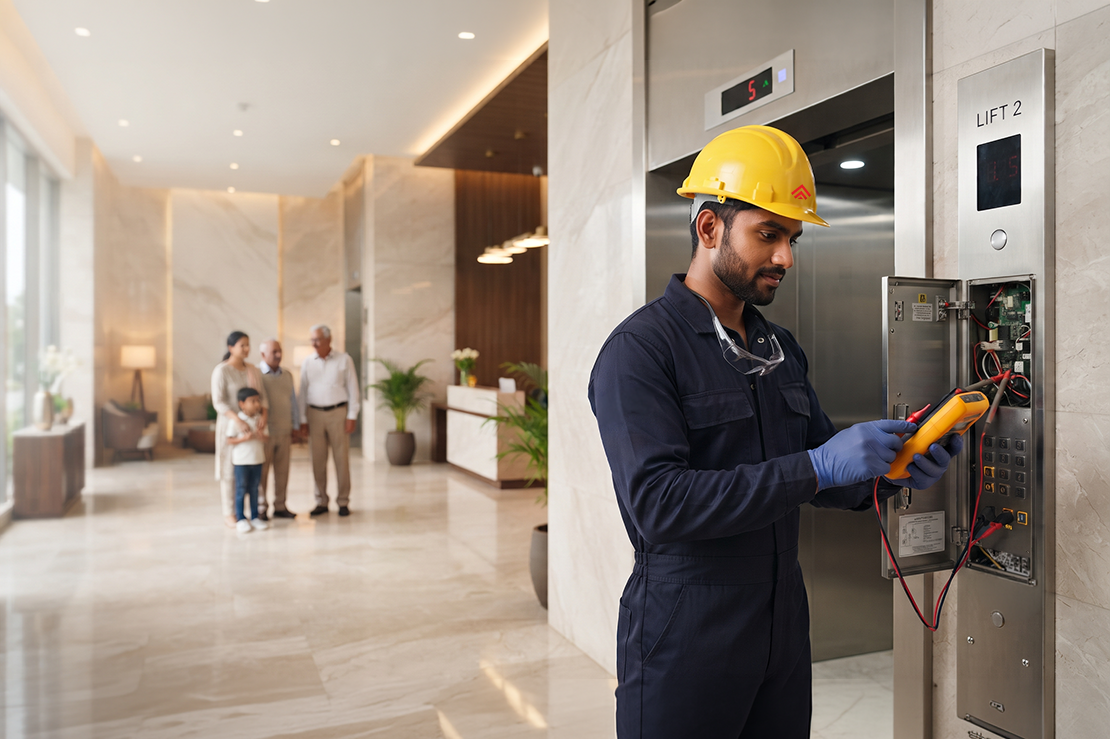
A lift should be noticed when it works, not when it stops.
In a residential community, an elevator failure is rarely just a technical problem. It immediately becomes an access problem, a resident communication problem and, during peak hours, a manpower problem.
For facility managers, the objective of elevator maintenance is therefore bigger than fixing faults. It is about reducing unplanned downtime, identifying repeat failures, and getting the asset safely back into service with as little disruption as possible.
Measure downtime before trying to reduce it
“The lift was down for a few hours” is not a useful maintenance record. Break the outage into measurable stages.
| Metric | What to measure | What it reveals |
| Response time | Fault reported → technician dispatched | Help desk and escalation efficiency |
| MTTR | Failure → verified restoration | Actual recovery performance |
| Repeat failure rate | Same fault returning | Whether the repair solved the problem |
| Parts waiting time | Diagnosis → part availability | Supply-chain bottlenecks |
| First-time-fix rate | Resolved without repeat visit | Quality of diagnosis and repair |
Track these by lift, tower, and month. A lift with frequent short failures may be a bigger reliability concern than a major breakdown that happens once.
Preventive elevator maintenance should look for change
A completed checklist does not necessarily mean a healthy lift. Good preventive maintenance looks for deterioration before it becomes a shutdown.
- Door operation, locks, interlocks, obstruction detection and unusual vibrations.
- Levelling accuracy, ride quality, and stopping behaviour.
- Traction equipment, ropes, sheaves, lubrication points, and abnormal noise.
- Brake condition and operating behaviour as specified by the OEM and applicable procedures.
- Controller and drive fault history, repeated trips, electrical connections and earthing.
- Emergency alarm, communication, lighting, and approved rescue systems.
- Pit and shaft condition, including water ingress and equipment cleanliness.
The useful question during inspection is not simply “Is this component working?” It is “Has its condition changed since the last inspection?”
Turn elevator maintenance data into an early-warning system
Predictive maintenance does not always require a new sensor platform. Existing controller fault logs, CMMS work orders, service reports, and complaint history can already reveal patterns.
- Trend recurring fault codes instead of counting only breakdowns.
- Flag lifts with increasing door, drive, or levelling faults.
- Track repeat calls after every major repair.
- Record parts that repeatedly cause extended downtime.
- Use CMMS to connect the asset, fault, technician, parts, and closure record.
- Where appropriate, use connected monitoring for remote status and early fault notification.
The KPI is not how much technology has been installed. The KPI is whether the information allows the FM team to act before residents experience the failure.
When the lift stops: control the response
A breakdown exposes the quality of the entire residential facility management system. The response should be structured, especially when passengers are involved.
- Confirm the lift ID, location, and reported condition.
- If passengers are trapped, activate the approved rescue procedure and authorised elevator service support. Never improvise a passenger rescue.
- Record the report time, response time, and fault indication.
- Escalate according to the agreed SLA.
- Keep residents informed about availability and alternate access where applicable.
- After repair, complete the required testing before returning the lift to service.
- Record cause, corrective action, parts used, and any repeat-prevention action.
Response time and restoration time should never be treated as the same KPI. A technician can arrive quickly while the lift remains unavailable because of diagnosis, parts, or testing.
Compliance is part of uptime
Lift compliance in India is not governed by one universal maintenance checklist. State legislation, applicable rules, inspection requirements, and the lift manufacturer’s procedures all need to be considered.
For example, Karnataka’s lift legislation was amended in 2025. FM teams should therefore maintain a location-specific compliance register covering licences, inspections, maintenance records, and required documentation.
Where residential facility management makes the difference
An elevator does not operate in isolation. Its reliability is connected to electrical systems, emergency power, fire and life safety, help desk response, vendor management, and resident communication.
That is why apartment maintenance services work best when technical maintenance and facility operations are connected through one system of ownership and reporting.
A 10-point elevator uptime review for FM teams
- Which lift has the highest unplanned downtime?
- Which fault repeats most often?
- How many breakdowns needed more than one visit?
- How much downtime was caused by parts availability?
- Are preventive tasks being completed on schedule?
- Are door or levelling faults increasing?
- Are critical spares identified for ageing equipment?
- Can the last 6 to 12 months of fault history be retrieved quickly?
- Are statutory inspections and records current for the location?
- Does every major failure have a root-cause or repeat-prevention action?
Choosing the right apartment maintenance services partner
If elevator reliability is part of the scope, do not evaluate a partner only on AMC price. Ask for evidence of operational control.
- Defined response and escalation SLAs
- Trained technical manpower
- Clear preventive maintenance scope
- Critical-spares planning
- CMMS or equivalent work-order traceability
- Monthly downtime and repeat-failure reporting
- Documented emergency procedures
- State-specific compliance tracking
- Vendor performance reviews based on measurable KPIs
Conclusion: Keep the lift moving before it stops
Reliable elevator maintenance is not about having someone to call when the lift fails. It is about building a system that makes failures less frequent, recovery faster, and recurring faults harder to ignore.
At UPS, we offer a comprehensive range of residential facility management services, including operations and maintenance, repairs and retrofits, fire and safety, AMC management, help desk support, vendor management, CMMS and IoT-enabled technology. More than 80% of our residential services are self-performed, ensuring greater control over service delivery and operational quality.
For residential facility management teams, the formula is straightforward: measure downtime, inspect for deterioration, use maintenance data intelligently, control emergency response, and hold every service partner accountable.
Explore UPS’ residential facility management services.
FAQs
How often should apartment elevators be serviced?
Follow the manufacturer’s maintenance programme, applicable state requirements, and the actual conditions of equipment usage. A fixed calendar alone should not replace condition-based observation.
What causes sudden elevator breakdowns?
Failures can involve door systems, controllers, drives, electrical conditions, sensors, brakes, levelling systems, or ageing components. The more useful maintenance question is whether the failure was preceded by a recurring warning that went untracked.
How quickly should a breakdown be resolved?
Use the site’s SLA and lift criticality to define the target. Track response, diagnosis, parts waiting, repair, and testing separately, so the real source of downtime is visible.
Can outsourcing residential facility management reduce elevator downtime?
It can when outsourcing brings stronger preventive maintenance, technical ownership, vendor governance, work-order tracking, and escalation. Outsourcing alone does not guarantee lower downtime.
What should an elevator maintenance vendor provide?
Look for competent technical personnel, required licences and records, defined SLAs, preventive maintenance documentation, emergency procedures, parts support, and measurable performance reporting.
Have any feedback or questions?
Contact us!