Cleaning Contract vs. Housekeeping Facility Management Services: What Your Apartment Association Actually Gets
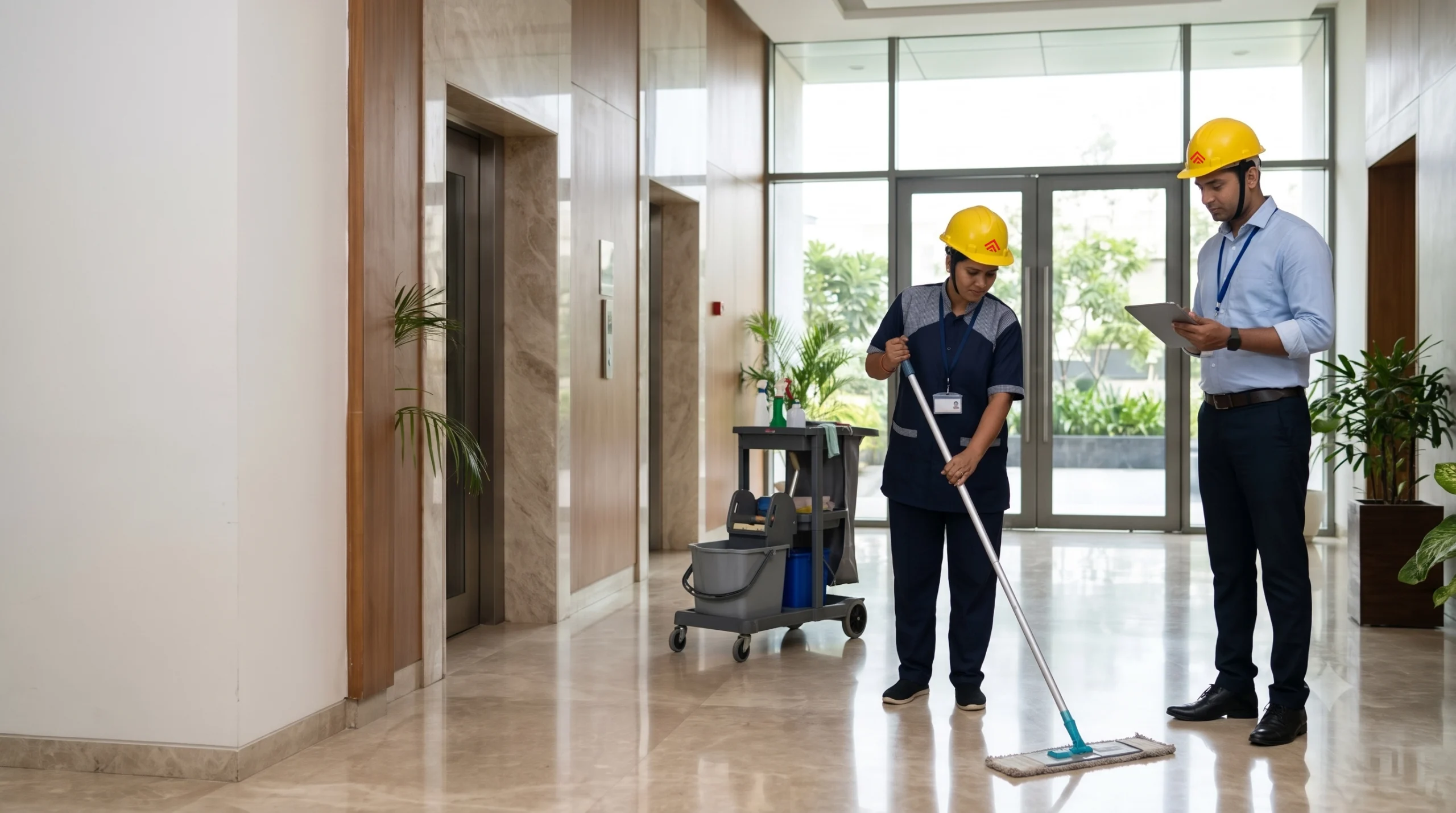
A contract says “daily cleaning.” But when a cleaner is absent, a lobby smells, or a resident complaint goes unanswered, a task list alone is not enough. The difference between a cleaning contract and housekeeping facility management services is the operating system behind the work: deployment, supervision, standards, and issue closure. Apartment committees should ask not only what gets cleaned, but how service gaps are corrected.
A cleaning contract usually defines tasks and manpower. Housekeeping facility management services can add supervision, quality checks, reporting, backup arrangements, and accountability. The written scope and SLA determine what is actually delivered.
What does a cleaning contract usually cover?
A task-led contract commonly covers sweeping and mopping common floors, lift cabins and lobbies, stairwells, shared washrooms, dusting, and routine waste collection. It may suit a smaller property with limited amenities and an association able to monitor delivery.
The control layer may be missing: who checks results, covers absences, handles complaints, and corrects recurring defects. Consumables, machines, deep cleaning, and outdoor areas should be specified, not assumed.
What are housekeeping facility management services?
Housekeeping facility management services manage cleanliness as a site operation, organised by zones, usage, and agreed standards. Depending on the contract, they may include deployment, attendance monitoring, supervision, SOPs, training, equipment and chemical planning, inspections, complaint tracking, and corrective action.
Residential housekeeping can interface with waste management, gardening, pest control, pool maintenance, and water management.
| What is evaluated | Cleaning contract | Housekeeping facility management services |
| Scope | Tasks and frequencies | Zones, methods, frequencies, and standards |
| Supervision | May be ad hoc or extra | Defined roles and inspection cadence |
| Training | Specify requirements | Induction and training records |
| Absence coverage | Terms may be unclear | Replacement and interim coverage defined |
| Equipment | Supply responsibility varies | Equipment and replenishment planned |
| Reporting | Task completion | Defects, complaints, and closure tracked |
| Compliance | Responsibilities may be unclear | Records and responsibilities documented |
| Complaint closure | May be informal | Owner, escalation, and verification defined |
| Cost | Often task/manpower based | May include supervision, equipment, and reporting |
| Oversight | Depends on contract clarity | Can be reduced with measurable SLAs |
Note: These are common models, not guarantees. A detailed cleaning contract can include the same controls, while an FM proposal can still be vague. Compare deliverables, not labels.
The details that make housekeeping services for apartments work
1. SLAs that can actually be checked
“Maintain excellent cleanliness” is not an audit standard. An SLA should name the zone, task, frequency, acceptance criteria, and inspection method. For a lift lobby, this might mean debris-free flooring and dry surfaces after wet cleaning.
2. Complaint handling that diagnoses, not just repeats cleaning
Log the location, time, issue, and recurrence. An odour may come from a drain, waste holding point, or wet area. Assign an owner, investigate, correct, and verify closure. Repeatedly dispatching a cleaner without finding the cause creates activity, not resolution.
3. Workforce and compliance visibility
Clarify who employs workers, which statutory records and insurance evidence are available, how attendance is recorded, and how replacement staff is inducted. Request documented compliance evidence and seek professional advice on specific obligations.
Committee checklist before signing
- Map common areas, amenities, waste points, and outdoor zones.
- Set tasks, frequencies, standards, and inspection methods.
- Confirm shifts, attendance, and replacement timelines.
- Request training, induction, and verification records.
- Clarify who supplies tools, machines, chemicals, and consumables.
- Define complaint ownership, escalation, and closure checks.
- Document compliance, insurance, reporting, and audit access.
- Compare full scope, exclusions, and oversight effort.
Why consider UPS for residential housekeeping services?
At UPS, we believe residential facility management goes beyond completing daily tasks. It’s about maintaining consistent standards, coordinating essential services, and creating a well-managed living environment.
Our residential facility management services include housekeeping, gardening, pest control, waste management, swimming pool maintenance, and OHT/sump cleaning. With defined processes, trained teams, and a coordinated approach, we aim to make day-to-day community operations more efficient and reliable.
Explore our Residential Facility Management
Conclusion
The best choice is not simply the cheapest contract or the broadest title. It is the scope that makes work, quality, and accountability visible. Housekeeping facility management services should define how tasks are delivered, checked, and corrected.
Frequently asked questions
What is the difference between a cleaning contract and housekeeping facility management services?
A cleaning contract specifies tasks, frequency, and manpower. Housekeeping facility management services may add supervision, inspection, reporting, escalation, and corrective action. The written scope and SLA are decisive.
Is a housekeeping contract enough for an apartment complex?
It may suit a smaller property with a simple scope and strong oversight. Multiple towers, basements, amenities, and heavy resident traffic may call for structured deployment, inspections, and complaint management.
What do housekeeping services for apartments typically include?
Typical tasks include common areas, lift lobbies, stairwells, shared washrooms, dusting, and routine waste collection. Deep cleaning, specialised equipment, external areas, and consumables may cost extra.
What should a housekeeping SLA include?
Covered areas, frequencies, measurable standards, inspection method, staffing and replacement rules, complaint escalation, reporting, corrective-action closure, exclusions, and commercial remedies.
Have any feedback or questions?
Contact us!