Housekeeping Needs: Factory vs Office vs Apartment
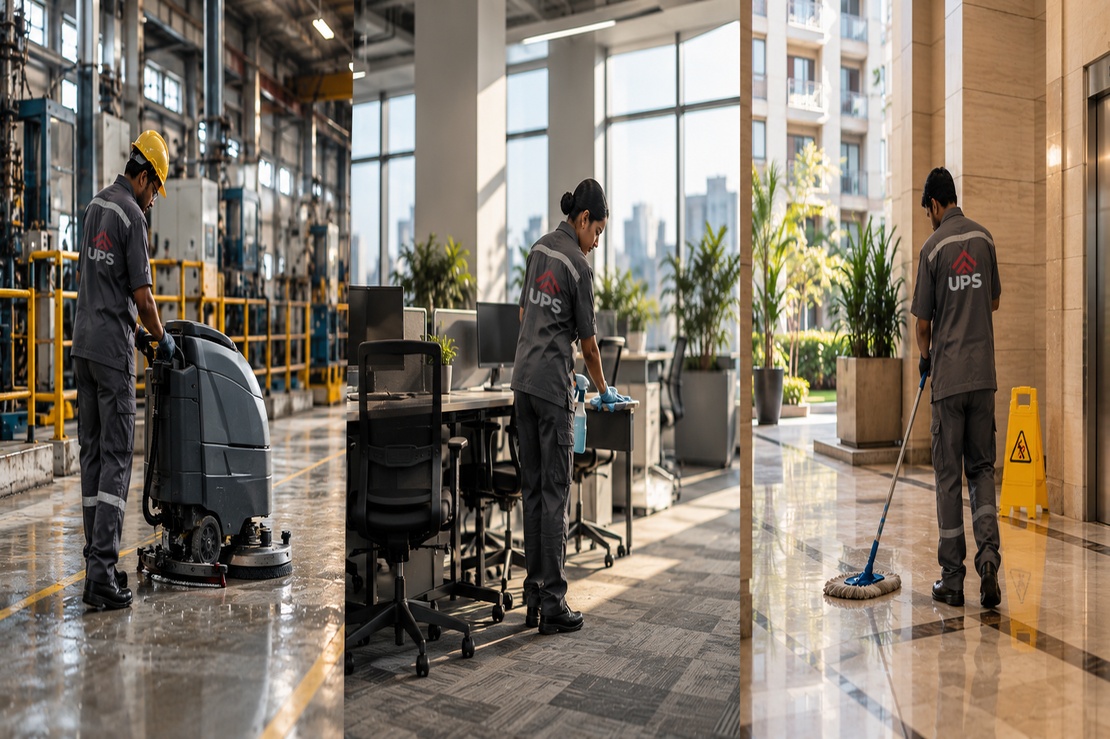
Why housekeeping facility management services differ across sites
A factory floor, a corporate office, and an apartment complex can all look clean at first glance. But the same cleaning routine cannot serve all three equally well. Fine dust near production equipment, a contaminated office pantry surface, and wet residue on an apartment staircase are different problems, with different consequences.
The useful question is not just how often an area was cleaned, but what can go wrong, how quickly, and what proves the control worked. That is the shift from cleaning by habit to managing housekeeping as an operational service.
Effective housekeeping facility management services start with site-specific risk assessment and clear service levels. Frequency should follow risk and use, not a universal checklist. High-traffic areas may need repeated attention; technical areas may require approved methods and restricted access.
What are facility management housekeeping services?
Facility management housekeeping services combine cleaning tasks with the routines that keep spaces hygienic, orderly, and safe to use. Depending on the site, this can include floor and surface care, washroom upkeep, consumable replenishment, spill response, waste collection, segregation, pest-control coordination, and inspection records.
Cleaning, hygiene management, and waste handling are related, not interchangeable
- Cleaning removes soil, dust, residues, and visible contamination from a surface.
- Hygiene management services define how contamination risks are controlled: which method is suitable, which products are permitted, how tools are separated, and how completion is verified.
- Waste handling controls what happens after material is discarded: segregation, safe internal movement, temporary storage, and handover to the appropriate authorised channel.
A surface can look clean but still have been treated with the wrong chemical or cloth. A bin can be emptied while waste is mixed. Good housekeeping checks both the method and the result.
where housekeeping fits in integrated facility management
Housekeeping intersects with engineering, safety, security, helpdesk, and waste management. Repeated water on a corridor floor may look like a cleaning issue, but the source could be a leaking pipe, blocked drain, or HVAC condensate. The team should control the immediate hazard and raise a work order for the underlying defect, rather than repeatedly removing the same water.
Factory vs office vs apartment: what changes?
| Control point | Factory | Office | Apartment |
| Primary risk | Process residues, dust, oil, movement routes, production safety | Shared touchpoints, washrooms, food areas, occupancy peaks | Slip hazards, common-area condition, waste points, resident access |
| Scheduling logic | Production windows, isolation needs, shift changes | Arrival peaks, meeting-room turnover, occupied hours | Daily routines, lift traffic, events, and collection timings |
| Methods and tools | Material-specific spill kits, approved industrial methods, suitable mechanised equipment | Area-separated tools, surface-compatible products, washroom kits | Floor-appropriate equipment, outdoor tools, waste collection, and spill response |
| Waste focus | Process residues and streams identified by site procedures | Paper, packaging, pantry and washroom waste | Wet, dry, sanitary, and special care streams, plus other waste as applicable |
| Evidence to retain | Zone inspections, spill records, safety escalations, task closure | Round sheets, washroom checks, replenishment and complaint closure | Common-area rounds, waste handover checks, event- and weather-related actions |
| Escalation example | Unknown residue near equipment | Repeated washroom odour or leaking dispenser | Recurring water ingress or mixed waste at collection point |
There is no universal rule that a factory must be cleaned a fixed number of times more often than an office. Set frequency by risk, occupancy, soil load, process requirements, and incident history.
What stays common across all housekeeping services?
SOPs that describe the method, not just the task
“Clean the floor” is not a complete SOP. A useful instruction identifies the zone, approved method, equipment and chemical where relevant, PPE, isolation or access requirements, waste route, acceptance criteria, and escalation trigger.
Training and supervision
Training should be task-specific. A worker assigned to an office pantry does not automatically have the competence to handle an industrial chemical spill. Supervisors should verify understanding through observation, refreshers, and recorded checks.
Audits that find patterns
An audit score becomes more useful when it reveals repeat failures. Track repeat findings by zone and type, time to close, recurrence after closure, and whether the cause was cleaning execution, equipment condition, consumable supply, or an upstream defect.
Digital tracking that improves control
A checklist or CMMS record should show what was due, what was completed, what failed inspection, and what remains open. Mobile logs can improve traceability when they record the zone, time, owner, finding, and closure evidence. Digital records support, but do not replace, physical inspection.
Find how a partner fits into the housekeeping requirement
When evaluating a housekeeping facility management services partner, ask how its site plan changes between industrial, commercial, and residential environments. Request sample zone schedules, training matrices, inspection criteria, waste handover procedures, and escalation workflows. These documents show whether the service is designed around the site or simply staffed to a headcount.
Conclusion: choose controls, not just cleaning hours
A factory needs housekeeping that respects process hazards and production flow. An office needs a responsive routine built around shared spaces and occupancy. An apartment complex needs dependable common-area care, weather-aware checks, and disciplined waste handling. The work may share a name, but the operating requirements are different.
The best facility management housekeeping services define the risk, specify the method, verify the result, and escalate what cleaning alone cannot fix. That is what turns housekeeping from a visible task into a managed facility function.
Explore UPS’ industrial, commercial, and residential facility management services through our website https://upsfm.com/.
FAQs on housekeeping facility management services
What’s the difference between housekeeping facility management services and hygiene management services?
Housekeeping covers tasks that maintain cleanliness and order. Hygiene management services add controls around contamination risk, suitable methods and products, separation of tools, verification, and records.
How many times does a facility need to undergo housekeeping?
There is no reliable universal frequency. Set schedules by occupancy, soil load, process risk, incident history, hygiene requirements, and how quickly a condition could become unsafe. Use scheduled rounds plus trigger-based response where needed.
Can one facility management company handle factories, offices, and apartments?
Yes, if it uses site-specific risk assessments, methods, training, equipment, and reporting. A single provider should standardise governance without forcing the same cleaning procedure onto every environment.
What should apartment complexes check for waste management in 2026?
The Solid Waste Management Rules, 2026 require source segregation into wet, dry, sanitary, and special care waste from 1 April 2026. Sites should confirm local-body directions, provide clear collection arrangements, and preserve segregation through handover.
belongs on a hygiene management services audit checklist?
It should include zone and task, method followed, tools and chemical compliance, PPE where applicable, visible results, waste segregation, consumable status, defects found, corrective action owner, due date, and closure verification.
When should a plant work with an industrial facility management services partner?
A partner may help where a plant needs additional technical coverage, consistent inspection routines, work-order governance, specialist condition monitoring, or better coordination between maintenance and operations. The scope should be defined against the plant’s actual risks and capabilities.
Have any feedback or questions?
Contact us!