Technologies Used in Predictive Maintenance for Construction Machinery
Introduction
Construction machinery works in unpredictable conditions. Excavators operate in dust and uneven terrain. Cranes handle fluctuating loads. Loaders shift between idle and heavy cycles within minutes. Maintaining this equipment has always been challenging. Unexpected breakdowns cause project delays. Emergency repairs inflate costs. Idle machines affect productivity across the site.
Traditional machinery maintenance relies mostly on reactive repairs. But in modern construction, that approach is no longer sufficient.
Predictive maintenance offers a smarter alternative. Instead of servicing machines based on time intervals, it analyses real performance behavior.
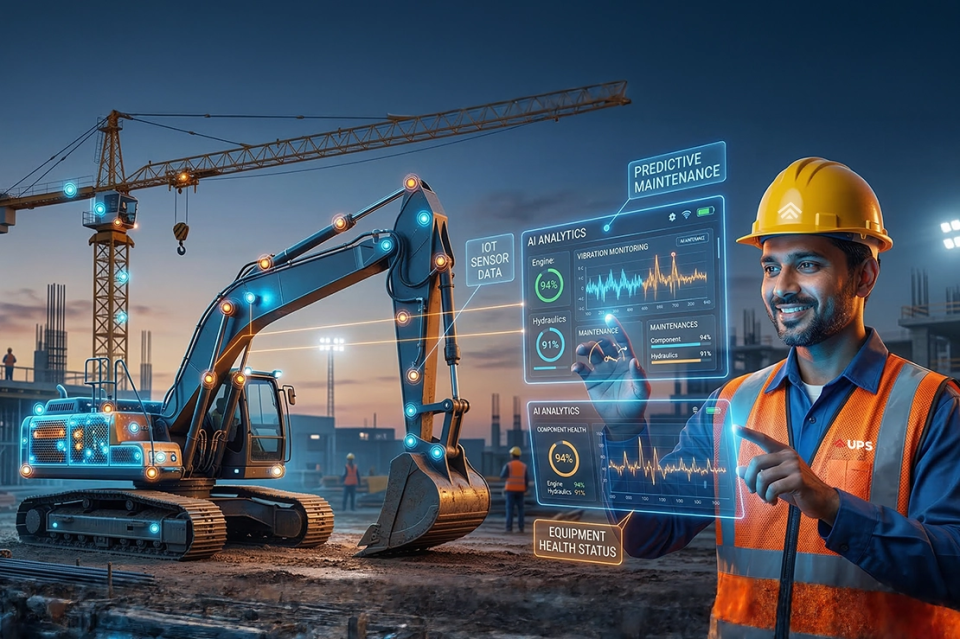
Predictive maintenance in construction uses advanced technologies like sensors, AI, and data analytics to monitor machinery health and prevent failures before they occur.
What Is Predictive Maintenance in Construction?
Predictive maintenance in construction is a data-driven approach that monitors equipment condition continuously and predicts issues before they lead to failure.
Reactive maintenance repairs after a breakdown. Preventive maintenance follows a fixed schedule. Predictive maintenance acts based on actual equipment behavior.
It has become essential in modern construction equipment maintenance because machinery is more connected, projects are time-sensitive, and downtime costs are higher than ever.
How does predictive maintenance work?
- Equipment generates real-time data
- Systems analyse trends and performance shifts
- Maintenance is scheduled before breakdown occurs
- Algorithms detect deviations from normal behavior
The focus is no longer on repairing damage. It is about identifying drift before damage happens.
Role of Technology in Modern Machinery Maintenance
Technology has changed machinery maintenance from inspection-based to insight-driven.
Earlier, technicians relied on sound, vibration, feel, or visual checks. Today, machines communicate their internal state. Modern platforms analyse load stress, energy consumption patterns, and cycle efficiency.
This shift reduces downtime, improves safety, lowers repair costs, and increases equipment lifespan. More importantly, it allows maintenance teams to prioritise based on risk rather than routine.
Key Technologies Driving Predictive Maintenance in Construction
1. IoT Sensors
IoT sensors track vibration, temperature, hydraulic pressure, fuel efficiency, and runtime behavior.
- Detect micro performance drift
- Identify abnormal stress patterns
Modern systems compare real-time readings against machine-specific baselines rather than generic thresholds.
2. Artificial Intelligence and Machine Learning
AI builds behavioural models of equipment. Instead of reacting to high temperature alone, it analyses combinations of signals.
- Creates failure signatures
- Predicts the probability of component fatigue
Advanced systems now estimate remaining useful life for critical components.
3. Data Analytics and Big Data
Analytics engines process millions of operating data points across fleets.
- Identify recurring usage stress
- Forecast maintenance demand
Companies can now predict fleet-wide service requirements months in advance.
4. Telematics Systems
Telematics integrates GPS tracking with performance diagnostics.
- Links operator behavior to wear patterns
- Monitors load distribution and idle time
This reveals how usage habits influence machinery health.
5. Condition Monitoring Systems
Condition monitoring focuses on bearings, motors, hydraulic systems, and structural stress points.
- Tracks continuous health indicators
- Prevents secondary failures
Instead of waiting for alarms, systems flag performance deviation.
Where Predictive Maintenance Is Used
Predictive maintenance is applied across excavators, bulldozers, cranes, loaders, and concrete machinery.
For example, vibration mapping in excavators detects early bearing fatigue. Load tracking in cranes prevents the accumulation of overload stress. Concrete batching systems utilise motor performance analytics to prevent shutdown during peak pours.
These applications reduce downtime and improve project efficiency by aligning machinery maintenance with actual site conditions.
Why Companies Adopt Predictive Maintenance
Companies adopt predictive maintenance because it improves operational stability.
- Prevents unexpected breakdowns
- Improves equipment reliability
- Reduces emergency repair costs
- Extends machine lifespan
- Supports project scheduling accuracy
Quick Answer:
Predictive maintenance helps construction companies reduce costs and improve machinery performance by fixing issues before failures happen.
Common Challenges and Limitations
Implementation requires investment in sensors, software, and skilled technicians. Data management can be complex. Integration with older equipment may require customisation.
The larger challenge is organisational. Teams must trust data-driven decisions rather than relying only on traditional experience.
Emerging Technologies in Construction Equipment Maintenance
Future systems are moving toward predictive automation.
AI-driven platforms will auto-schedule service windows. Digital twins will simulate machine wear under different load scenarios. Cloud-based monitoring will centralise fleet intelligence. Autonomous diagnostics will allow machines to self-report performance risks.
Predictive maintenance in construction is evolving from monitoring systems to predictive ecosystems.
FAQs About Predictive Maintenance in Construction
What is predictive maintenance in construction?
Predictive maintenance in construction is a technology-driven method that monitors equipment performance data to identify early warning signs and schedule service before failure occurs.
How does predictive maintenance reduce costs?
It reduces emergency repairs, minimises downtime, and prevents secondary damage by addressing issues early.
Is predictive maintenance better than preventive maintenance?
Yes, because it relies on real-time conditions rather than fixed schedules, improving efficiency and resource allocation.
Which machines benefit most from predictive maintenance?
Excavators, cranes, bulldozers, loaders, and concrete machinery benefit significantly due to heavy operational stress.
Steps to Get Started
- Conduct a detailed equipment assessment
- Install machine-specific monitoring sensors
- Use advanced analytics platforms
- Train teams in data interpretation
- Review and refine performance insights regularly
Conclusion
Technology-driven machinery maintenance is redefining equipment reliability in construction. Predictive maintenance in construction transforms traditional machinery maintenance into a proactive, data-driven strategy that improves reliability, safety, and operational efficiency.
For construction companies looking to reduce downtime, control maintenance costs, and extend equipment life, adopting predictive maintenance is no longer optional.
Explore how UPSFM’s construction equipment maintenance solutions can support your operations. Partner with UPSFM to build a smarter, more reliable maintenance strategy.
Visit upsfm.com
Have any feedback or questions?
Contact us!