From Resident Complaints to Quick Resolutions: The Role of the Integrated Help Desk in Facility Management
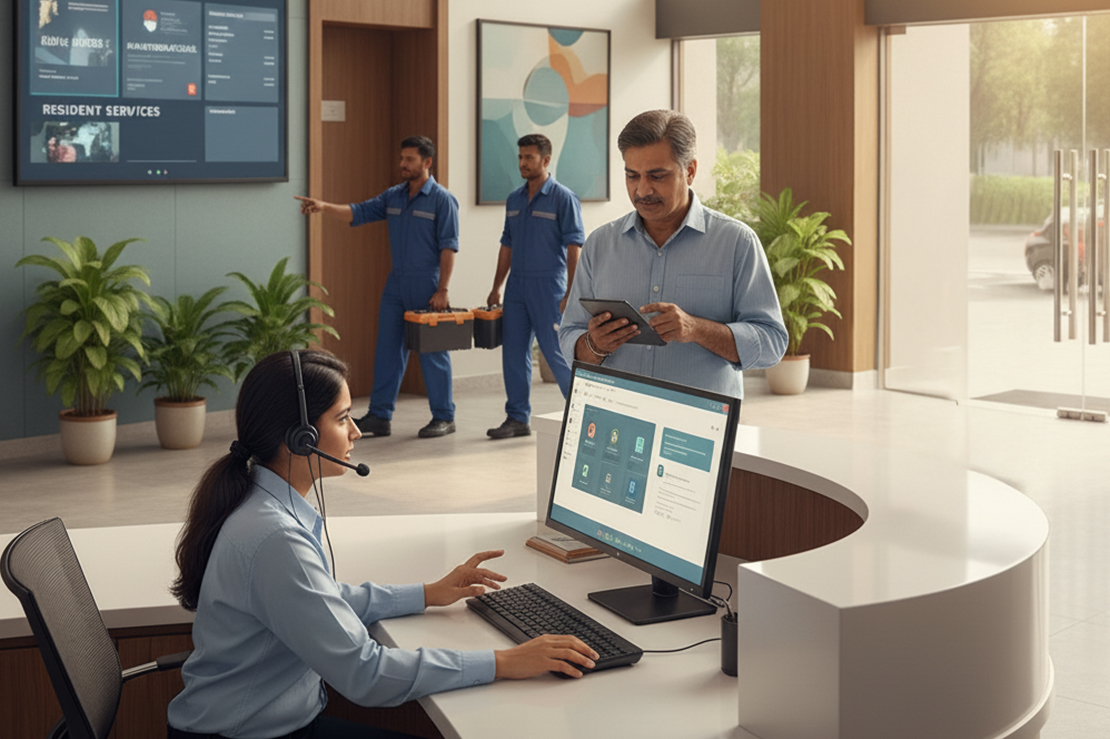
Have you ever messaged about a leaking tap and had to wait days to get a response? Such a lag will easily erase trust. Now imagine logging your maintenance request in one dedicated portal, getting an immediate acknowledgement, and receiving updates until the job is done. That’s the difference a robust, integrated help desk facility management system makes, turning frustration into confidence.
What is an Integrated Help Desk in Facility Management?
An integrated help desk in facility management is a unified platform for resident or employee complaints. Whether lighting, plumbing, HVAC, or security, problems are effortlessly reported, seen, and fixed. Instead of having to deal with phone calls, messages via WhatsApp, and paper files, this system consolidates it all. It connects users, service teams, and facility managers in a streamlined workflow, so every request gets assigned, seen, and finished with accountability.
With this system, each service request becomes a ‘ticket’: captured, categorised, assigned to the right technician or vendor, tracked through to resolution, and closed only after confirmation. This not only reduces response time but also removes the ambiguity and chaos of ad-hoc maintenance requests. The platform supports effective facility management complaint tracking and ensures that service teams are working on the right issues at the right time.
Why Complaint Tracking Matters in Residential and Industrial Facilities?
Effective facility management complaint tracking is not just a convenience but a foundation for service quality. Here’s why:
- Nothing gets forgotten: With a ticket system, every issue gets registered and monitored until it gets fixed. Verbal requests or misplaced WhatsApp messages become documented service actions.
- Clear ownership & accountability: Assigning each task to a specific technician or team means someone is responsible. Managers can monitor pending tickets, ageing tasks and bottlenecks.
- Better satisfaction, fewer follow-ups: When users see their requests acknowledged and updated (‘Technician will arrive between 2-4 pm’, ‘Spare parts on order’), they feel heard, and your reputation improves.
- Priority becomes visible: In residential settings, a leaking pipe may be urgent; in an industrial plant, machine downtime could be critical. Tracking helps differentiate and expedite accordingly, which in turn saves cost and prevents disruption.
- Data that supports decision-making: The accumulated ticket history reveals recurring problem zones. Be it a building’s drainage network, equipment fatigue, or vendor performance. This transforms reactive fixes into a proactive strategy.
The value of maintenance help desk solutions emerges when minor complaints are tracked just as well as major ones, enabling a consistently responsive facility environment.
Key Benefits of Integrated Help Desk Systems
Deploying smart maintenance helps desk solutions deliver multiple layers of value:
- Faster response times: From request to technician dispatch, process automation cuts delays.
- Transparency in resolution: Residents and stakeholders can see progress updates. No more guessing or chasing.
- Data-driven insights for managers: How many tickets are opened and closed each month? Which categories dominate? What’s the average resolution time? These metrics inform budgeting, staffing, and vendor strategy.
- Stronger preventive maintenance planning: Frequent complaint types signal underlying issues. With tracking, you can convert reactive fixes into scheduled preventive programmes before major failure hits.
- Higher resident and employee satisfaction: When people live or work in a space where problems get addressed quickly, it naturally builds trust in those running the place, and that trust tends to spark better engagement across the board.
In real-world terms, bringing in a help desk for facility services isn’t just about handling daily requests more efficiently. It also lays the groundwork for smarter long-term decisions around asset management and controlling costs.
Real-Life Applications in Facility Management
Here’s how a modern help desk for facility services shows up across different settings:
- Residential Societies: A resident logs a water leakage issue via the portal. The system categorises it under plumbing, assigns the in-house technician, and alerts the resident: ‘Technician will reach in 30 minutes.’ After resolution, the resident approves closure. Meanwhile, management sees the ticket status via a dashboard and tracks counts of plumbing issues by block over time.
- Industrial Plants: A machine fault triggers a complaint. The integrated help desk records it, assigns the maintenance team, logs parts used, notes downtime, and eventually helps identify that the same motor fails every six months, triggering a preventive replacement plan rather than repeated breakdowns. This reflects a strong facility management complaint tracking capability.
- Commercial Offices / Corporate Buildings: An HVAC complaint gets logged, vendor dispatched, updates sent (‘Technician arrived’,‘Repaired & tested’). Manager reviews the monthly dashboard showing HVAC-related tickets are down 40 % compared to last quarter, thanks to the insights driving preventive cycles. The integrated help desk facility management system not only resolves issues but also helps improve building performance over time.
How Facility Managers Can Use Integrated Help Desks for Better Outcomes?
Successful facility managers who utilise an integrated system successfully can enhance service delivery as well as make operations more efficient.
- Track ticket-solving timeframes: Establish SLAs (e.g., ‘all plumbing complaints fixed in 24 hours’), examine ageing tickets weekly, and jump in on backlogs.
- Look for repeated problems and take steps to prevent them: If the elevator has problems often in one building, plan a complete inspection instead of making quick repairs. The trend data held in the maintenance help desk solutions platform enables this.
- Inform users of the present state at once: Automatic messages (‘We received your complaint’,‘The technician will arrive between 10-12 am’, ‘The problem is solved’) clarify everything and reduce questions.
- Use information to develop strategies: Complaint types, time to resolve, cost per complaint, vendor performance. All this information from the help desk aids budget spending, training needs, contract negotiations, and long-term facility planning.
- Take advantage of in-house capabilities and training: It’s more control, faster, and higher quality service to have a trained staff in-house rather than relying solely on external vendors.
These are practical ways to turn maintenance aid desk solutions from just a tool to a valuable part of facilities management.
Conclusion
Today’s fast-moving built environments demand more than ad-hoc fixes and vanished complaints. A centralised help desk system combined with structured complaint-tracking has become mission-critical for facility management.
By adopting such systems, facility teams resolve issues faster, users feel genuinely heard, and managers gain clear oversight and control.
Underpinning these advanced practices is one clear principle: dependable service, transparent procedures,and accountability in execution. That’s precisely what UPSFM delivers across its residential, industrial, and corporate clients, creating environments where complaints become rare and confidence remains high.To explore customized facility management plans, contact us.
Have any feedback or questions?
Contact us!