Resident Safety in Gated Communities: How Integrated Security and Fire Safety Services Protect Your Family
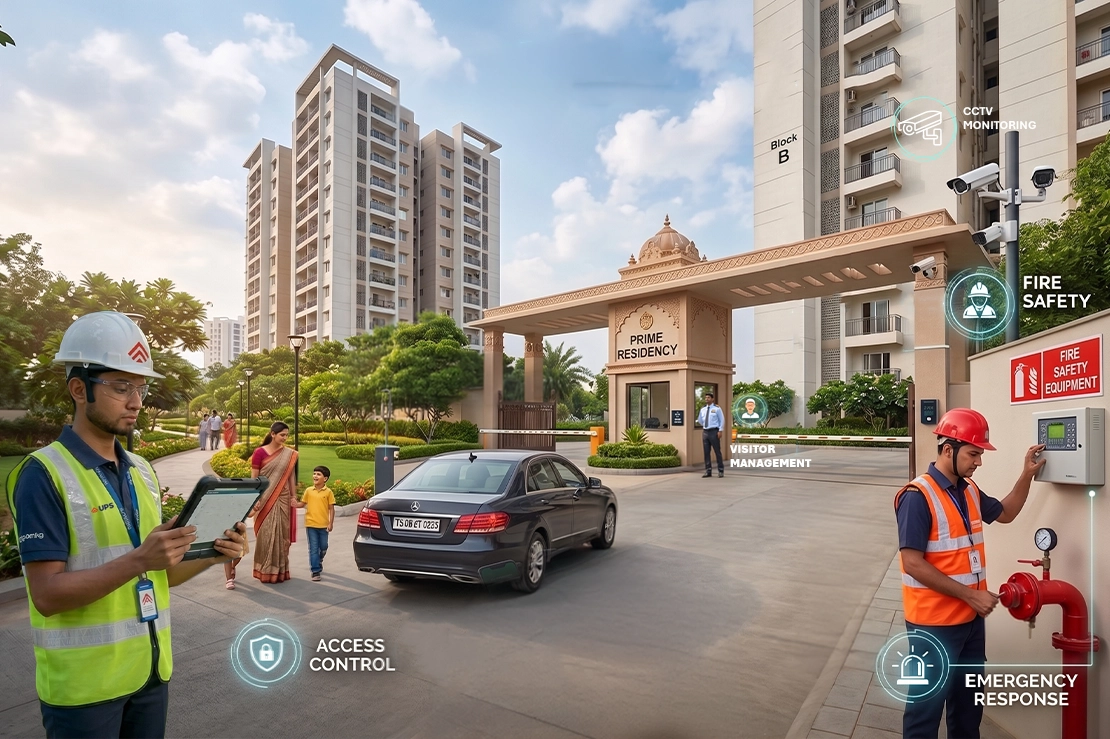
A gate, a guard and a CCTV camera are not a safety system. Three separate props only look like one when nothing has gone wrong yet. Chennai’s apartment stock has crossed a density where that gap between looking safe and being safe actually gets tested, by fire, by a medical emergency at 2 am, or by someone who simply walked in behind a delivery rider. This piece is written for residents, RWA committees and the facility managers who already know the buzzwords. What follows is the operational detail behind them.
What does resident safety in a gated community actually mean?
Strip away the marketing language, and resident safety comes down to four layers working as one system, not four separate vendors billing separately:
• Deterrence: perimeter, lighting, visible patrolling and access control that make an incident less likely to start.
• Detection: CCTV analytics, fire and smoke sensors, panic buttons and visitor logs that catch it early.
• Response: trained personnel who know the escalation matrix, not just the gate register.
• Accountability: one entity that owns the outcome when audits, drills and real incidents are compared against each other.
Most complexes have layers one and two. Very few have three and four, and that is exactly where the incidents that make the news come from.
The security risks that most gated communities underestimate
Visitor management failures and unauthorized entry
The manual visitor register is still the default in a large share of gated communities. And it fails in a specific, predictable way: it verifies that someone signed a name, not that the name is real or that the resident actually approved the entry. Tailgating behind delivery and e-commerce riders during busy hours is the single most common unauthorized-entry pattern, simply because the volume of legitimate riders makes gate staff wave people through without a call back to the flat. A signed register is a record of activity, not a control.
Parking and gate management blind spots
Fire tender access lanes inside a complex are the first casualty of informal parking. A car parked across a fire lane, tolerated because ‘it’s only for ten minutes’, is exactly the kind of encroachment that turns a two-minute response into a much longer one on the one night it matters. Sticker-based vehicle identification also ages badly in practice. Stickers get transferred, photocopied, or simply ignored by a guard managing dozens of vehicles during a shift change, which is why RFID tags and number-plate recognition are steadily replacing static stickers at better-managed complexes.
Untrained guards and high attrition
This is the underestimated risk that quietly undoes everything else. Guarding contracts are frequently won on price, and the guard standing at the gate today may not be the one standing there next quarter. A complex that treats guarding as a commodity is effectively re-onboarding a large share of its security staff every year, and every new joiner who has never walked the refuge floor route or seen the fire panel light up is a resident-safety gap, not a staffing statistic. Training and retention are the two levers that actually determine whether a guard freezes or acts correctly in the first ninety seconds of an incident.
Fire and safety systems: Are yours compliant and tested?
Common fire safety compliance gaps in Chennai apartments
- Refuge floors converted into gyms, storage, or party halls, which defeats the purpose of a floor that exists to stay clear for an emergency.
- Fire NOC renewal lapsed after the original occupancy stage, with no internal tracking of the renewal cycle.
- Sprinkler heads painted over during routine maintenance, which delays or blocks activation.
- DG rooms and electrical shafts are used as informal storage, adding fuel load exactly where an ignition source already exists.
- Fire safety plans exist as a framed certificate in the lobby rather than a document the guard team has actually walked through.
High-rise apartment towers carry specific, height-linked obligations, refuge floors at defined intervals, fire lifts, wet risers, and hydrant systems that are easy to satisfy on paper at handover and easy to quietly erode over the following few years as maintenance priorities shift elsewhere. The gap almost never shows up in a routine walkthrough. It shows up in an audit that actually tests the system.
What a professional fire safety audit reveals?
A real audit, not a document review, physically tests the system rather than checking that a certificate exists on file:
• Hydrant and downcomer pressure test at the farthest riser point, not just the one nearest the pump room.
• Fire pump auto-start sequencing under a simulated power failure.
• Public address system audibility inside stairwells and basements, where echo and equipment noise often defeat announcements that test fine in the lobby.
• Refuge area access, checking the passage is unobstructed and the fire-rated door actually closes and latches.
Mock fire drill protocols and resident training
Quarterly mock drills are treated as a compliance checkbox almost everywhere. They are more useful when residents don’t know the exact date in advance, when the drill includes a partial stairwell block to force use of an alternate route, and when the post-drill debrief is documented and shared with the RWA rather than filed and forgotten. A drill that residents can predict is not measuring evacuation readiness; it is measuring whether people can walk downstairs on request.
CCTV surveillance and access control in modern residential complexes
Camera count is the wrong metric. What matters in 2026 is whether footage is retained long enough to be useful after the fact, whether analytics flag loitering or tailgating instead of just recording passively, and whether the CCTV feed is actually integrated with the visitor management and access control system so a flagged event triggers a guard response instead of sitting in cold storage until someone requests it after the fact. Facial recognition at entry points is gaining adoption but raises real privacy and data-retention questions residents should ask about before their FM company enables it, not after.
How integrated facility management unifies security and safety under one team
The case for integrated facility management services is not about billing convenience. It is about what happens in the ninety seconds after an alarm trips, when a fragmented vendor structure forces a phone-call chain and an integrated one triggers a single, rehearsed response.
| Failure point | Fragmented vendor model | Integrated FM model |
| Fire alarm triggers, guard reacts | Guard calls RWA, RWA calls fire vendor, vendor calls back in minutes | The same command centre dispatches guard response and fire escalation simultaneously |
| Audit findings | The fire auditor’s report sits with the RWA secretary; the security vendor never sees it | Findings feed directly into guard SOPs and shift briefings |
| Accountability after an incident | Three vendors, three contracts, three explanations | One facility manager, one incident report, one point of liability |
| Staff turnover impact | The new guard has never seen the fire panel or the refuge floor route | Onboarding checklist includes site fire plan walkthrough before first shift |
What to look for when hiring a residential facility management company for security and safety
Guard training standards and statutory compliance
- Valid security licensing for the state of operation.
- Documented training and police-verification records available per guard, not just per agency.
Fire safety audit and mock drill frequency
- A written audit calendar, not ‘as required’.
- Mock drills at genuinely unannounced intervals, with documented debriefs.
Technology: visitor management, CCTV, access control integration
- One dashboard, not three logins across three vendor apps.
- A clear, written answer on data retention and who owns the footage.
Single-contract accountability for all safety services
One SLA, one escalation matrix, one point of contact who cannot blame a subcontractor.
Key Services Inside an Indus Conclusion: don’t wait for an incident; get a free safety assessment for your complex trial IFM Contract
Every gap covered above: the unverified visitor, the blocked fire lane, the untrained guard, and the converted refuge floor reads as a minor inconvenience right up until the one night it isn’t. A residential facility management company worth its contract will walk your complex, flag these gaps in writing, and show you exactly where fragmented vendors are quietly leaving your community exposed. If your association is reviewing its facility management partner, speak with the UPSFM team to understand how an integrated approach can strengthen safety, accountability, and day-to-day operations.
Frequently asked questions about security and fire safety in residential complexes
- How often should fire safety systems be audited in an apartment complex?
A full technical fire audit at least once a year, with internal self-inspections monthly and mock evacuation drills every quarter, is the working standard most compliance-focused facility management companies now follow. The audit and the drill test different things; one tests the equipment, the other tests the people, and a complex needs both.
- What are the fire safety compliance requirements for high-rise apartments in Tamil Nadu?
High-rise apartment towers need fire clearance from the state fire department both at the planning stage and after construction, along with refuge floors, fire lifts, wet riser and hydrant systems, and automatic detection and alarm systems sized to the building’s height and occupant load. The applicable fire safety requirements are prescribed by the Tamil Nadu Combined Development and Building Rules, 2019, read with the National Building Code, and depend on factors such as building height, occupancy, and use. If a building undergoes an extension, structural alteration, or change in occupancy, additional compliance requirements may apply.
- Can an RWA manage security and fire safety without a professional FM company?
An RWA may choose to manage security and fire safety directly or engage a professional facility management company, provided the community continues to meet all applicable statutory and safety requirements.
- What is visitor management, and why does every gated community need it?
Visitor management is the system, digital or manual, that verifies and logs who enters a complex, ties that entry to a specific resident’s approval, and creates a timestamped record. It matters because the paper register that most complexes still use cannot actually verify identity or resident consent, only that a name was written down, which is the exact gap that tailgating and unauthorised entry exploit.
- How much does integrated security and fire safety management cost for a 300-unit complex?
Costs vary widely by guard count, shift structure, technology stack, and whether fire safety audits and AMC are bundled in, so any figure quoted without a site walkthrough should be treated as a placeholder rather than a quote. The more useful comparison is cost per unit per month under one bundled integrated contract versus the sum of separate security, fire AMC, and CCTV vendor contracts, since the fragmented total is almost always higher once duplicated supervisory overheads are accounted for.
Have any feedback or questions?
Contact us!