Why Automotive Plants Lose Crores to Unplanned Downtime – And How Industrial FM Prevents It
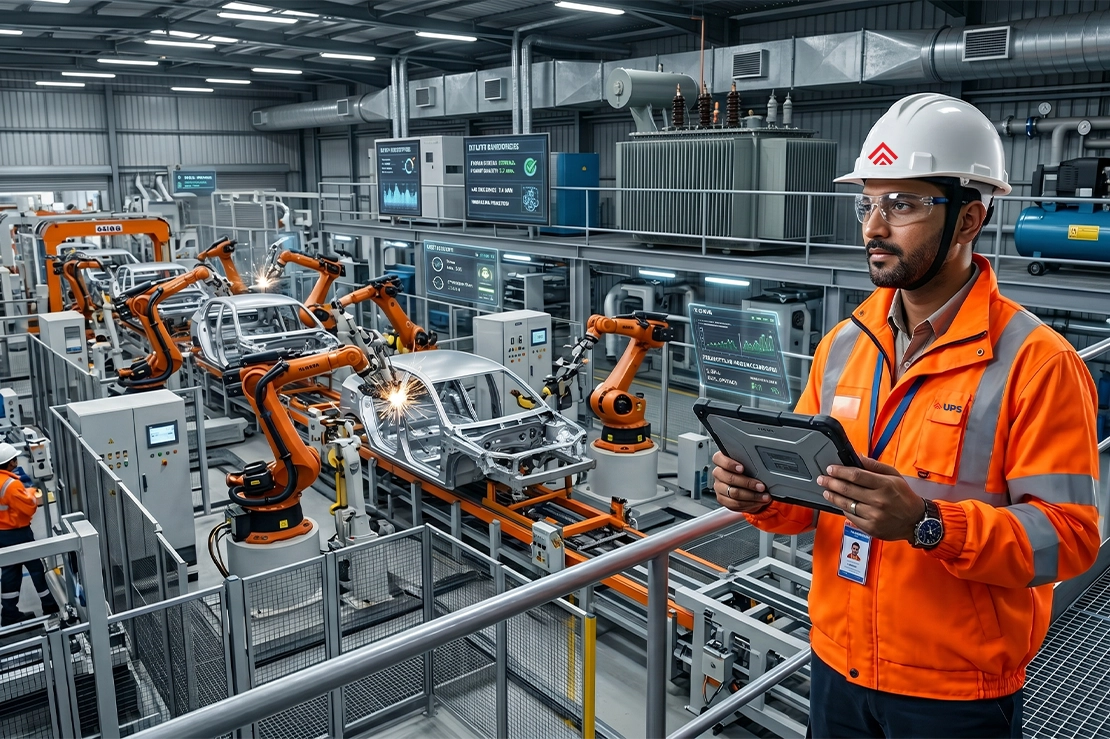
Walk into any automotive plant at 3 AM, and the real test isn’t the assembly line. It’s the powerhouse, the compressors, the ETP humming quietly. Nobody notices these until they stop, and the unplanned downtime cost in an automotive plant turns ugly fast when they do.
Why Operational Reliability Depends on More Than Production Equipment
When people hear “facility management,” they picture someone mopping a corridor or fixing a leaky tap. That needs to change. The real version is closer to plant engineering than housekeeping. It’s the quiet discipline of keeping every non-production system, the power, the water, the compressed air, and the climate control, working in step with whatever the production line needs that day.
The Critical Systems Working Behind Every Production Target
A plant manager who’s worked with both knows the difference between an FM vendor and an industrial facility management services provider almost instantly. The genuine version runs four distinct buckets at once: utility O&M (your DG sets, transformers, HT/LT panels, boilers, compressed air systems), support for production-adjacent equipment, environmental compliance work like ETP, STP, and emissions tracking, and the usual admin or soft services on top. Most contractors only show up for that last bucket, the easy one, and still call themselves an FM company.
Self-performance vs multi-vendor model
Plants juggling separate vendors for electrical, HVAC, and civil lose 15-20 man-hours weekly to handoffs during a single breakdown. A self-performing FM partner removes that lag; one team owns the whole utility stack.
The real cost of unplanned downtime in Indian manufacturing plants
For a mid-size component plant, an hour offline can swing ₹3–8 lakhs, before OEM penalties, expedited freight to save JIT schedules, and a Tier-1 customer quietly auditing your reliability scorecard.
Which utility systems fail most, and why
Compressed air leaks (often 25–30% of generated air lost through worn fittings), transformer hotspots from poor load balancing, and cooling tower scaling from untreated water are the usual offenders. These are slow degradations nobody logs until output drops.
Reactive vs preventive: the cost gap
Reactive repairs run 3–5x costlier once you factor in expedited spares, overtime labour, and the cascading damage that follows. A worn bearing left unchecked doesn’t just fail; it takes the motor coupling down, too.
What good FM intervention looks like on the shop floor
Picture a plant where utility trips were treated as routine, until someone pulled the CMMS logs and traced every recurring compressor trip to one undersized cable run overheating under peak load, not the compressor itself. That’s engineering-led FM versus firefighting: fixing the cause nobody looked for, not the symptom everyone sees.
The 5 most common causes of utility failure
Loose electrical terminations, poor boiler/cooling-tower water treatment, compressed air leaks, skipped thermal imaging on panels, and missed lubrication. Industrial plant maintenance services close these gaps through scheduled thermography, vibration analysis, and oil condition monitoring.
The preventive maintenance manufacturing plant framework
Daily: power house, DG sets, HVAC, compressed air, boiler readings
Daily logs on DG coolant temperature, battery voltage, air dew point, and boiler blowdown frequency catch drift before it becomes a failure.
Weekly/monthly: conveyors, CNC machines, ETP/STP
Weekly conveyor alignment checks, monthly CNC spindle vibration readings, and ETP sludge density monitoring keep compliance and production support aligned.
The CMMS and IoT layer
CMMS for industrial facilities turns tribal knowledge into data, MTBF trends, and spare consumption rates. At the same time, IoT sensors flag anomalies before a round-checking technician would.
What to look for in an industrial FM partner
Track record in utility maintenance management manufacturing relies on in-house technical depth, CMMS maturity, SLA for critical utilities, automotive-sector experience, and transparent reporting. An industrial FM company that plants can trust should execute 90%+ of work through directly employed technicians, since accountability dilutes with every subcontracting layer.
Conclusion
Unplanned downtime isn’t a maintenance problem. It’s a planning gap. Facility management in the automotive industry in India increasingly treats utilities as seriously as production lines, because they’re the same risk in different uniforms.
This is the principle UPSFM is built around: a self-performing industrial FM partner that puts engineers on utility systems before they fail, not after. For plant heads tired of reactive firefighting, that shift in approach is often the difference between a downtime report and a quiet, uneventful shift.
FAQs
What does industrial facility management include?
Utility operations, equipment support, environmental systems, and admin services under one accountable team.
How does CMMS reduce unplanned downtime?
It tracks failure history and intervals, flagging assets due for service before they break.
Utility O&M vs production maintenance?
Utility O&M keeps the plant’s support backbone running (things like DG sets, transformers, and water systems) while production maintenance focuses directly on the manufacturing machinery itself.
Cost of industrial FM for an automotive plant in India?
Varies by plant size, typically a percentage of asset value or a fixed monthly contract.
Which sectors does industrial FM cover beyond automotive?
Pharma, FMCG, electronics manufacturing, and process industries use similar models.
Have any feedback or questions?
Contact us!