What Happens When Your Housing Society’s STP Fails? A Real Scenario and How FM Companies Prevent It
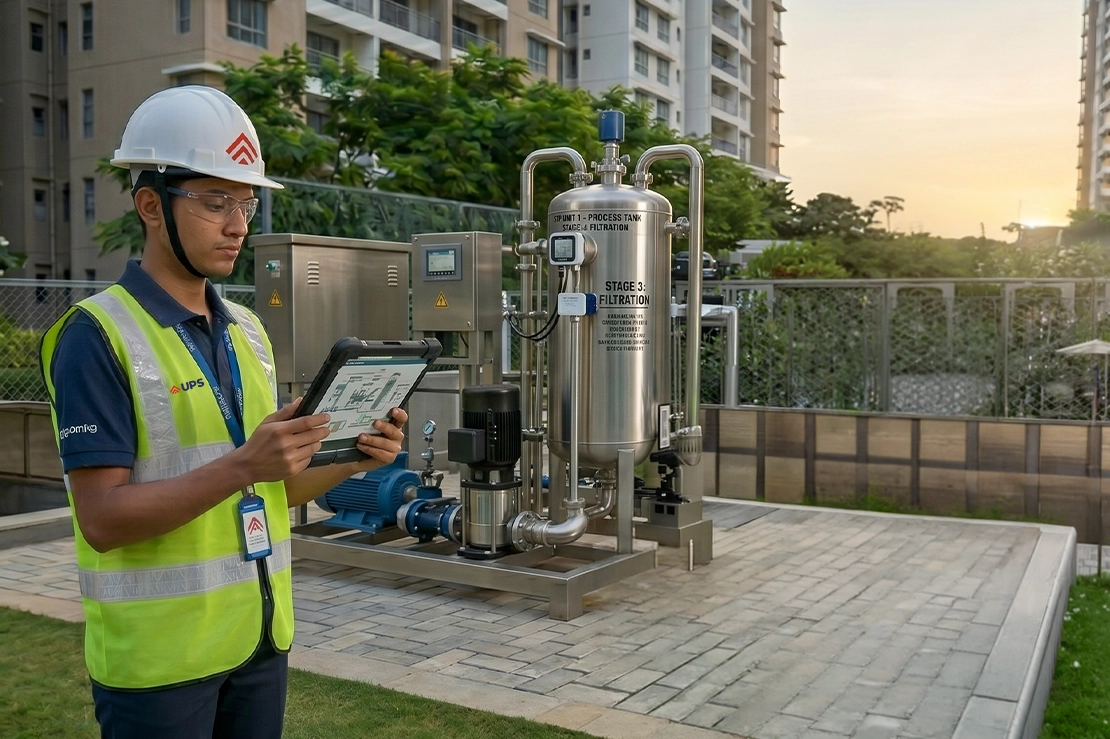
What is an STP, and Why Does Every Residential Complex Need One?
A Sewage Treatment Plant (STP) is one of the most critical yet overlooked assets in a residential complex. It treats wastewater generated from kitchens, bathrooms, laundries, and common facilities before the water is either reused or discharged according to regulatory norms.
Today, most large residential developments operate a sewage treatment plant system not only to meet compliance requirements but also to reduce freshwater consumption through recycling.
Most residential communities become aware of STP problems only after symptoms such as odour, water quality concerns, or compliance deviations begin appearing, highlighting the importance of proper residential complex STP maintenance practices.the facility.
Why STP Performance Issues Extend Beyond Maintenance
Health Risks for Residents
An underperforming STP can increase bacterial growth, foul odours, mosquito breeding, and contamination risks around utility zones. Poorly managed systems without a reliable STP O&M company can worsen these conditions over time.
Poorly treated water may also affect landscaping areas and reuse networks, creating secondary hygiene concerns.
Legal Exposure and TNPCB Penalties
Repeated non-compliance can result in notices, penalties, and increased scrutiny, often seen in complexes lacking structured residential complex STP maintenance systems.
Tamil Nadu Pollution Control Board (TNPCB) regulations require residential complexes to maintain prescribed discharge standards for parameters such as:
Repeated non-compliance can result in notices, penalties, and increased scrutiny, often seen in complexes lacking structured residential complex STP maintenance systems.
Financial Fallout: Emergency Repair vs Planned AMC Costs
Emergency interventions typically cost significantly more than planned maintenance.
A failed blower, damaged diffuser network, or overloaded sludge handling system often triggers:
- Emergency contractor deployment
- Tank cleaning
- Component replacement
- Laboratory testing
- Compliance restoration activities
This is why many societies rely on an experienced STP O&M company for preventive planning.
Reputation Damage and Property Value Impact
Residents may tolerate occasional lift downtime. They rarely tolerate sewage odour.
Persistent issues in a housing society’s sewage treatment plant often become discussions in resident groups, influencing community perception and long-term property appeal.
Understanding the Progression of an STP Failure in Housing Societies
Stage 1: Performance Degradation Begins
Most failures do not begin with equipment breakdown. They begin with a process imbalance.
Common examples include:
- Declining dissolved oxygen (DO) levels
- Diffuser choking
- Uneven sludge recirculation
- Rising Mixed Liquor Suspended Solids (MLSS)
- Excessive grease loading
At this stage, proper residential complex STP maintenance practices can prevent escalation.
Stage 2: Compliance and Operational Risks Emerge
As biological treatment efficiency drops, operators may notice:
- Increased odour generation
- Foam formation
- Higher turbidity
- Rising BOD and COD levels
Many societies only recognise the problem when issues escalate due to lack of structured sewage treatment plant monitoring.
Stage 3: Resident Impact and Recovery
Once the issue escalates, residents are faced with a long list of disruptions. Corrective actions often involve:
- Process stabilisation
- Sludge removal
- Aeration system restoration
- Blower servicing
- Water quality testing
Recovery is significantly faster when managed by a professional STP O&M company with defined protocols.
Professional STP maintenance residential complex programmes include:
- DO monitoring
- pH testing
- Pump inspection
- Blower performance verification
- Flow-rate checks
- Treated water observation
- Weekly Tasks: Keeping the System Clean and Efficient
Weekly activities typically include:
- Diffuser inspection
- Sludge level monitoring
- Screen cleaning
- Grease trap assessment
- Valve functionality checks
- Monthly and Quarterly: Compliance, Sludge, and Audit Reports
A competent STP O&M company focuses on:
- Laboratory analysis
- BOD and COD testing
- Preventive servicing
- Calibration of instruments
- Compliance documentation
- The Technology Layer: IoT-Based Automated STP Monitoring
Modern automated STP apartment systems increasingly use:
- IoT sensors
- Remote monitoring dashboards
- Blower energy analytics
- Predictive maintenance alerts
- SCADA-based controls
These systems significantly improve residential complex STP maintenance efficiency and reliability.
What to Look for When Hiring an FM Company for STP Maintenance
Before selecting a service provider, evaluate:
- Experience managing residential STPs
- Availability of certified operators
- Laboratory testing capabilities
- Compliance reporting systems
- Emergency response protocols
- Predictive maintenance capabilities
- Experience with automated STP infrastructure
Many leading Chennai residential FM services providers now act as a full-scale STP O&M company, offering integrated monitoring and management.
Conclusion
STP failures rarely happen without warning. More often, they develop through unnoticed process deviations, delayed maintenance, and lack of structured residential complex STP maintenance systems.
The difference between a well-performing and failing system in a housing society’s sewage treatment plant often comes down to proactive monitoring and technical expertise from a reliable STP O&M company.
At UPSFM, our approach combines preventive maintenance, compliance management, process monitoring, and operational expertise to help residential communities maintain efficient, compliant, and reliable sewage treatment systems.
Because when it comes to STP operations, prevention is always less expensive than recovery.
Connect with UPSFM to ensure your residential STP remains efficient, compliant, and future-ready. Visit upsfm.com.
Frequently Asked Questions About STP Maintenance in Residential Complexes
How often should an STP be serviced in an apartment complex?
Daily operational monitoring should be supported by weekly inspections and monthly preventive maintenance activities.
What is the penalty for STP non-compliance in Tamil Nadu?
Penalties vary depending on severity and are governed by TNPCB regulations for housing society sewage treatment plant compliance.
Can a housing society run its own STP without a professional FM company?
While possible, most societies prefer a professional STP O&M company for process stability, compliance, and technical troubleshooting.
What is an automated STP, and how does it help residential complexes?
An automated STP uses sensors, controls, and remote monitoring systems to improve efficiency and support STP maintenance in residential complex operations.
What is the cost of STP maintenance for a 500-unit complex per year?
Costs vary based on plant capacity, technology, and whether a dedicated STP O&M company is managing operations.
Have any feedback or questions?
Contact us!